Macro Thoughts: The Cure for High Prices Is… High Prices — Why the Short Side Matters Too

As we write, front month oil futures are back near the highs, north of $100 a barrel. The Iran conflict is disrupting energy flows, and trend strategies are long oil and refined products, short bonds. Direct exposure to markets at the forefront of concern.

We have long written about the benefits of portfolios broadening the tools in the toolbox of diversification into trend following strategies as they give systematic exposures to a genuinely different risk premia, historically uncorrelated most of the time and negatively correlated in equity and bond crises. While the only perfect hedge is in a Japanese garden (although my now 80 year old English father may stake a pretty good claim), when building out diversified portfolios, this is a good combination. Long and short exposures in commodities, currencies and fixed income.

Continue reading

Landman and CTAs

The mark of great writing is encapsulating the essence of a complicated idea in a memorable and accessible way. It’s more than a little humbling that this scene from Landman in a little over 20 seconds does a better job than our previous 90 blog posts and 8 whitepapers in explaining futures markets, economic risk and (with some poetic license) our approach to portfolio construction and CTAs (Managed Futures). In the show, Tommy Norris is a Texas oil fixer and explains oil pricing like this:

“You want oil to live above 60 but below 90. And don’t get me wrong, we’re still printing money at 90, but… gas gets up over $3.50 a gallon, it starts to pinch. It hits a hundred, every product in America has to readjust its price. $78 a barrel, that’s about perfect. You know, brings enough profit to keep exploring, but it don’t sting as much at the pump.”

Continue reading

VaR Shocks — Anatomy of a Forced Deleveraging

A digital stock market chart displaying fluctuating graphs in red and green, with lightning bolts striking across the image, suggesting volatility.

Every now and then the market reminds you that the most dangerous risks aren’t the ones you can see coming. They’re the ones embedded in the risk management systems themselves. Value-at-Risk (VaR) shocks are one of those paradoxes in finance where the tools designed to keep portfolios safe can end up making everything worse. Understanding how they work, and why they matter, is essential for anyone managing leveraged portfolios or trying to make sense of the violent dislocations that periodically rip through markets.

The basic idea is straightforward enough. Many portfolios size their positions based on some measure of expected risk – typically volatility, asset correlation, and the resulting VaR. In calm markets, volatility is low, correlations are well-behaved, and risk models give you the green light to run bigger positions. Life is good, until something upsets the apple cart. Volatility spikes, correlations jump, everybody’s risk model says the same thing at the same time – cut risk.

Below is a deliberately simplified illustrative simulation to walk through the mechanics of a VaR shock. Think of it as a stylized version of what happens in the real world when a stress event hits a volatility-targeted portfolio, whether it’s a risk parity fund, a sector and factor neutral fund, a spread trader or a trend follower. Any leveraged strategy that dynamically adjusts exposure based on realized risk metrics.

We use two assets, each running around 15% annualized volatility in normal times, with correlations near zero. The portfolio targets a 15% volatility max and sizes positions accordingly. With two uncorrelated assets at 15% vol each, the math is generous as the diversification benefit from near-zero correlation means you can hold around 70-80% in each asset (roughly 1.5x total exposure) and still run portfolio-level volatility comfortably below the 15% limit, closer to 10%. That’s the beauty of diversification working as intended. Low correlations give you leverage capacity for free. The risk model sees calm vol, calm correlations, and allocates accordingly. Everything is in equilibrium. Now let’s break it.

Continue reading

Portfolio Management – Planning for Uncertainty

The turn of calendar years are interesting times to take stock of how market prices evolved compared to what was expected to transpire a year or two ago. This can serve as a great lesson in humility and an appreciation in the uncertain nature of the world. We also think it makes the case for investment strategies that can adapt and navigate uncertainty to shift allocations in broader portfolios.

Remember the end of December 2021? Interest rates were at rock bottom pandemic levels (itself an exercise in who-knows-what-can-happen) while the S&P 500 was around 4800, riding high on free money forever. Fed Funds futures markets at that time expected December 2023 rates to be about 1.4%….by December 2022, those forward looking interest rate expectations had moved to 4.65%, CPI had hit 9% in the summer of 2022 and the stock market had fallen 20%. Inflation and interest rate fears were everywhere. Over the course of 2023, interest rates actually went up higher than expected – currently 5.33% – and as of December 31, 2023, the stock market is within a whisker of 4800 again.

When it comes to markets and the economic environment, nobody knows anything for sure. The NY Fed puts out forecasts for output growth over the next few years, the most recent one is below. With 90% confidence, four quarter percentage change in output growth in the US over the next year should be between -6.9% and +9.6%. That’s a 16% band! So, the smartest people in the room are sure of at least one thing – the world is very uncertain and there are no crystal balls.

Source: newyorkfed.org, The New York Fed DSGE Model (12/22/2023)

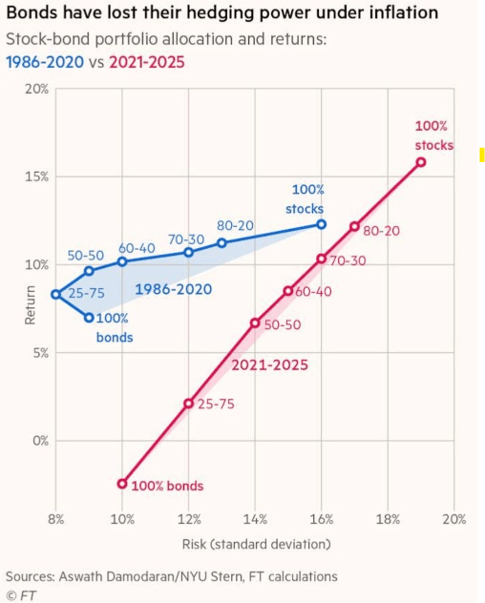
Portfolios need to have elements that can adapt to diversify across a wide range of outcomes. A popular framework is the quadrants approach – balancing risk in assets that do well in different combinations of inflation and growth. After decades of low and steady inflation in developed markets – even after periods of incredibly loose monetary policy and decently tight labor markets – many portfolio constructs ignored the high inflation box and just focused on protecting against the low growth outcome, relying on bonds alone to diversify. When inflation came roaring back, these portfolios struggled. Managed Futures shined for a couple of reasons related to inflation. First, it allows short exposures in fixed income. Second, it has a bigger toolbox of assets to allocate to, including commodities and currencies. This combination allows Managed Futures to adapt to the changing environment.

Keeping in mind that there is no crystal ball, what sources of uncertainty do we see on the horizon as we look ahead to 2024? And how does that create opportunity for Managed Futures? Big questions. Markets tend to move aggressively when things don’t turn out as expected and Managed Futures can be framed as exposure to this uncertainty.

Let’s start with the big markets.

Stocks

The stock market is close to record highs and trading at fairly expensive multiples – assuming 2023 SPX earnings come in at the 215 currently expected, we are at a 22 PE. Using 2024 expectations of 240, you get a forward PE a little under 20. Over the last few months, the valuation multiple has expanded. This has been driven in part by the expectation of interest rate cuts over the next couple of years being sooner and greater than previously expected, as inflation normalizes, and the Fed reaction function is being reassessed. We will see how that plays out, but stocks are not cheap right now and priced for a smooth, soft landing. It sure seems like a good time for the diversification Managed Futures can provide.

Fixed Income and Currency

Rates look to have peaked and markets assume inflation is solved but markets have sure been wrong before on the pace of inflation reduction as well as the Fed reaction function. These are complex, reflexive systems. If they are right, Managed Futures will move to long positions in fixed income. If inflation is stubborn, however, and doesn’t continue to come down as quickly or the Fed is spooked by the rapid loosening of condition, yields could go back up. The USD implications of a shifting monetary policy landscape are also large, as the past few years have seen a strong dollar against major currencies driven in part by rate differentials. Witness the large move down in the Japanese Yen over the past few years. US rates went up 500bps, at 75bps a clip for a time, while the Japanese maintained the Policy Balance Rate at -10bps. Should the Japanese decide to end the period of extraordinarily low rates while the US is cutting rates by 150bps, we could see large shifts in the yen. FX moves are often driven by diverging monetary and fiscal policy stances – the last mile of inflation may well be bumpy and experienced differently in different countries. We also have elections in the US and the UK that could usher in very different policy. Chinese stimulus measures and the subsequent impact on the ‘commodity’ currencies of Australia and Canada could also drive currency volatility and uncertainty. Managed Futures offers exposure to these different countries and currencies.

Commodities

We see similar potential for moves in commodity markets, where there are growing imbalances. Copper is a great example. The world may be sliding into a Copper deficit over the coming years, impacted on the demand side by the continuing shift to a renewable energy infrastructure and electric vehicles as well as on the supply side through political disputes in producing countries. That this worsening deficit picture is happening amidst the downturn in Chinese property makes us wonder what happens if stimulus measures are enacted there. Oil markets are also likely to be in focus as the forces of incredible US supply growth creates tensions with OPEC production cuts and continuing Russia sanctions…and heightened tensions in the Middle East. It only takes a couple of million barrels a day either way on supply and demand to move markets a big way. Grain markets also may be coming off a period of low supply and see the high prices of the past couple of years dissipating. Managed Futures offers exposure to these uncertain commodity markets.

Summary

In our view, portfolios benefit from being adaptable and need to make the most of the tools that are available to best navigate uncertainty. Direct commodity exposures. Long exposures AND short exposures. Managed Futures gives that flexibility. The charts below show two different periods of maximum uncertainty – the GFC years and the inflation/war in Ukraine/rates years. This uncertainty was not good for traditional assets. Managed Futures was able to navigate the uncertainty and diversify. The color coding details the strategy exposures through the periods – the most interesting thing to us is that it shows the adaptability. In the GFC, the right thing to do was long bonds and short commodities. In the inflation years, the right thing was short bonds and long commodities. Managed Futures offer maximum flexibility to adapt to a wide range of outcomes.

Data from Bloomberg and Mount Lucas as of 12/31/2022. Past performance is not indicative of future results. This presentation is for informational purposes only and does not constitute an offer to sell or a solicitation of an offer to buy securities or futures. Any offer for an interest in a fund sponsored by Mount Lucas will be made only by the offering memorandum of that fund. The performance shown for the MLM Index EV is based upon a historical index. Results reflect the reinvestment of dividends and other earnings. Results do not represent actual trading and do not reflect the impact that material economic and market factors might have had. A description of Mount Lucas’ investment advisory fees can be found in part 2 of its form ADV. The S&P 500 index is an unmanaged index consisting of 500 stocks chosen by the Index Committee of the Standard and Poor’s Corporation that generally represents the Large Cap sector of the U.S. stock market. Returns for the S&P 500 index reflect the reinvestment of all dividends. Trend Signal strength represents the strength of the trend signal in each of the MLM Index EV constituent markets ranging from -100% to +100%.

Dirty Portfolios – James Bond(s) Version

A few months back we introduced the concept of “Dirty Portfolios”, that add Managed Futures to traditional asset mixes the same way one adds olive juice to a martini to get the infinitely preferable dirty martini. That piece looked at a variety of popular asset allocation approaches and showed that adding Managed Futures improved returns, reduced volatility and drawdowns. It can be found here and has a lot of background info worth reading if you missed it – and apologies in advance for the tortured Dirty Harry quotes.

We received a lot of good feedback! One note we received a few times; “You guys looked at a lot of stock heavy asset allocations, but what about us fixed income investors. Can Managed Futures help diversify here also?”

In keeping with the movie references, here we take a look into fixed income and “license to kill” James Bond(s) quotes. Luckily, he liked a martini already, so we are halfway there. With the Spectre of high inflation causing a SkyFall in fixed income, could portfolios have been neither shaken nor stirred? (Sorry)

A Brief History Of Bond Yields

Sean Connery’s Dr. No hit screens in 1962. The US 10-year yield was right around where it closed 2022, 3.9%. Bond yields and Bond films peak at the same time with For Your Eyes Only in the early 1980s. 14 years later, as Timothy Dalton took over, yields were still high at 8.3%. As Pierce Brosnan pulls on the tuxedo they are 6.0%, as Daniel Craig takes over, 4.6%. In particular, this past 40 years or so have been incredibly good for bond portfolios, as yields reached what looks to be a nadir early in the pandemic at 0.5%. (We’ve ignored Lazenby because…well it was just one movie. Really good one though). Additionally, taking some poetic license, “The Brosnan Years” will be referred to as “The Best Years” for the remainder of this piece.

Source: Bloomberg (US Generic Govt 10 Yr), Mount Lucas

Since the premiere of the latest (last?) movie, No Time to Die in September 2021, the Fed has raised rates 450bps. In 2022 fixed income markets, there was no place to take (A Quantum of) solace. The Bloomberg US Agg Total Return Index returned -13.0%, the largest annual loss in decades. Managed Futures strategies performed well; as a proxy, the MLM Index EV (15V) returned 36.7%. Managed Futures strategies have a habit of doing well when other markets struggle, as it tends to hone in on the factors causing distress. 2022 was no different. The year was characterized by war in Ukraine driving commodity prices higher and high inflation causing interest rates to rapidly rise from pandemic induced lows, which in turn contracted earnings multiples in equity markets. For those parts of the bond markets with credit components, spread expansion added to the duration woes. Emerging market fixed income also suffered.

For the fixed income allocator, the benefit of Managed Futures strategies is that they can be positioned either long or short directly in fixed income markets. Managers typically trade a wide variety of global bond markets at different points on the yield curve and utilize leverage. This means you don’t need to add a very large amount of the strategy to a Fixed Income portfolio to see meaningful benefits, and at the top portfolio level the Managed Futures portfolios work to move around the entire portfolio duration systematically. Managed Futures strategies also get exposure directly in other markets impacted by fixed income prices – commodity exposures participate in inflationary and deflationary themes while currency markets are often expressions of relative interest rates. Indeed, in 2022, the shorts in the Japanese Yen and longs in the oil complex helped generate returns. Over the longer term, Managed Futures strategies are uncorrelated to fixed income markets, adding uncorrelated elements to portfolios improves risk adjusted portfolio returns.

Source: Bloomberg (US Treasury Total Return Index), Mount Lucas (MLM Index EV (15V))

Portfolio Allocation – The Dirty Answer

As we did in the last piece, here we try and answer the main questions on how to use Managed Futures. How much should someone allocate? Fixed income markets are not all the same, ranging from short duration US Treasuries to long duration emerging market or high yield corporate bonds. The “right” amount of a Managed Futures allocation we think would vary depending on the type of fixed income portfolio. Different risk profiles and different asset mixes lead to different answers. We think that even the most risk averse portfolios could benefit from some amount of Managed Futures. Below we show the addition of Managed Futures to some different sectors of the Fixed Income markets, creating a “Dirty” version. As parts of the Fixed Income markets are newer than others, some of the portfolios go back farther than others. Data runs through the end of 2022. For the Managed Futures exposure we use a combination of the original MLM Index (15V) and the MLM Index EV (15V), as we believe it to adequately represent the space in a passive fashion. Portfolios are rebalanced monthly – if you want to Die Another Day…rebalance.

Summary Data

The table below shows the summary total return data over different time periods. Generally, higher total returns, lower drawdowns, similar to lower levels of volatility and much improved in 2022. Optimized solutions look for meaningful Managed Futures allocations – 20-50%.

Continue reading

Managed Futures – 2022 Review

Introduction

2022 was a banner year in the Managed Futures space. Stocks and bonds both had a tough time, something that’s fairly rare. The S&P 500 Total Return Index returned -18.1%, the Nasdaq-100 Total Return Index fell -32.5%. The Nasdaq saw its high for the year on the opening day and the low a couple of days after Christmas. The Bloomberg US Agg Total Return Index returned -13.0%. The chart below illustrates how infrequent negative returns are in both asset classes.

If there was a year when a strong Managed Futures return would be most helpful, 2022 was it.

Below we will examine how investors use the asset class and review the key drivers of returns last year. We will then analyze the various quantitative approaches to trend following, how they explain dispersion among managers, and how they have performed historically and in 2022, when needed most.

Overview – Managed Futures

Many investors look at Managed Futures through a lens of absolute returns over economic cycles, uncorrelated to stock and bond markets. This lens looks at the broader range of markets available in Managed Futures – currencies and commodities typically – and both the long side and short side of return distributions available such that one isn’t reliant on prices always going up to generate positive returns. Either up or down is fine, as long as prices trend. Choppy sideways is bad.

Other investors look for Managed Futures as ‘Crisis Risk Offset’ strategies that they expect to generate returns during equity market declines and recessions, somewhat akin to put options or highly rated government bonds. This lens sees Managed Futures as capitalizing on flows that recessions and panics tend to coincide with – equity markets down, commodity markets down, flight to quality dynamics in currencies and fixed income.

In 2022 Managed Futures certainly delivered on both these counts, providing uncorrelated returns in the worst 60/40 market in decades.

In Part 1, we use the MLM Index EV methodology to examine how Managed Futures generated returns in 2022, looking in detail at the underlying market moves by asset class, highlighting some individual positions that contributed, and showing how some of the different approaches to Managed Futures impact returns. The MLM Index EV does a fine job at explaining and capturing the beta we believe exists in the space and using some different derivations in the parameters can offer some insight, particularly in big, interesting years.

In Part 2, we deconstruct Managed Futures returns into their contributing factors. Performance dispersion for any given Managed Futures strategy is generally driven by some combination of the following approaches by each manager:

  • Volatility – the level of overall strategy volatility that is expected or targeted
  • Trading speed – short, medium, long or blend lookback
  • Trend approach – simple moving average, slope, crossover, breakout, etc.
  • Market universe – more markets, less markets, alternative markets, sector allocation
  • Position/Risk management – how positions are sized, rebalanced, and volatility adjusted

Of course there is more going on, but in the same way equity indices can be constructed to target different styles or factors like growth/value, low volatility or by sectors, Managed Futures returns can be somewhat deconstructed along the lines above. It can be useful to take a look in detail at how each of the changes impacts the nuances of Managed Futures results.

Continue reading

Dirty Portfolios – Managed Futures As A Portfolio Element

Most investors know and understand the traditional 60:40 portfolio of stocks and bonds. There are many other model portfolios, with clever names and metaphors, out there blending different weights and different assets. Almost all benefitted from the low rate, low inflation market environment. So far, 2022 has been difficult across the board for these models as stocks, US Treasuries, and credit have all fallen, and even short-dated bonds have not helped.

To keep things interesting, we illustrate the role of Managed Futures in the portfolio below while having a bit of portfolio naming fun. We start with several of the more popular asset allocation models and garnish them with some Managed Futures. The same way adding an olive to a martini makes a dirty martini, can we enhance a classic by adding a Managed Futures “twist” and creating a “dirty” version? Apologies in advance as we then torture the ‘dirty’ reference with Clint Eastwood quotes.

Background

The primary role of Managed Futures strategies is to diversify the portfolio, and allocators should always strive to evaluate those strategies under that context. When accessed through a pure trend following approach, Managed Futures offers an uncorrelated, positively skewed portfolio element with a positive expected rate of return that can complement the broader portfolios of equities, credit, and real estate.

The risk premium earned by investors participating in Managed Futures inherently has a different driver than equity markets. Think simply about how Goldman Sachs is structured. The investment bank side raises money for everything from companies to municipalities through equity and credit underwriting. The other side manages trading desks to facilitate the risk transfer of exogenous operational price risks that impact the running of a business. Both are risk premiums that companies face; markets exist to transfer them to investors. These two risk premiums are complementary, but they need to be accessed differently. One funds economic activity by investing in equity and credit securities from the long side, directing capital to those who seek to expand and transfers their capital risk. The other takes on exogenous input and output cost risks in commodity prices, currency movements, and changes in interest rates, facilitating hedging that allows businesses more price certainty in operations while focusing on their core expertise. Crucially, this risk premium needs to be accessed from both sides of the market: trend following long and short. The combination of the two risk premiums is very attractive, as one side thrives on stability and rising growth, while the other thrives in times of economic uncertainty and macro volatility that typically hurts equity and credit investors.

Put simply, where the investor premium in equity and credit markets looks for cash flows, the investor premium in the futures markets looks for “crash” flows.

Portfolio Allocation – The Inflation Problem

Traditional portfolio construction generally assumes holding long positions in different asset classes and relying upon low asset correlations to build better portfolios. Over the last few decades, an environment of declining bond yields and low inflation meant that, generally speaking, bond prices would rise any time stock markets fell meaningfully. As markets began to price that, in the event of any serious economic slowdown or episode of poor market functioning, the Federal Reserve would come to the rescue and cut rates. Somewhere during the pandemic this reached a nadir on two fronts. First, bond yields in developed markets reached such low levels that price appreciation on bonds became difficult to envisage. Take a typical 10yr bond with a duration of 8 for example. Starting at 400bps yields and dropping to 200bps would make 16% (simplified for ease). With yields bouncing around 50bps, it is hard for long dated yields to move meaningfully lower. Second, the stock bond correlation of the past 40 years generally relies upon inflation being reasonably low and steady. When inflation is notably higher, the economic link between stocks and bonds starts to break down as the Fed is less willing to reduce rates. Welcome to 2022 – both stocks and bonds have fallen. Those that use leverage to increase the risk profile of stock and bond portfolios have been particularly hurt. Sometimes bonds can diversify stocks, sometimes bond price falls can be the driver of what is hurting stocks.

For the portfolio allocator, the benefit of adding Managed Futures is that it can be either long or short different assets, giving it the ability to adapt positioning across different market regimes, including getting short bonds early this year. How long does the current regime last? No one knows, but as a portfolio element (2022 through the time of writing at the end of Q3), Managed Futures has diversified stock and credit portfolios pretty well, similar to the experience of previous crises in 2000 and 2008 (albeit those were deflationary, not inflationary).

Portfolio Allocation – The Dirty Answer

Yet, decades of complacency have left portfolios underexposed to investments that have historically done well in times of price uncertainty and volatility, and ill-equipped to handle the current market environment. For the allocator looking for exposure to these factors, several questions come to mind when considering Managed Futures. How should they be used? What allocation should they get? Great questions. The tough part- the answer is, as always, client driven. Where you stand, depends on where you sit. Different risk profiles, different asset mixes, different goals lead to different answers on what is right. Returns? Drawdowns? Volatility reduction? All fine ways to frame the approach.

To answer some of these questions, and to prioritize how typical investors allocate capital, we show the addition of Managed Futures to some typical portfolio allocations, creating a “Dirty” portfolio. As many of the portfolios have different asset mixes for which data isn’t always readily available, some go back further than others. Data runs through the end of Q3 2022. For the Managed Futures exposure we use the MLM Index EV (15V). We believe it to adequately represent the beta in the space while having some features that make it particularly useful as a diversifying portfolio element. In short, the MLM Index EV (15V) doesn’t contain equity markets, it does not adjust position sizes for volatility, and it passively represents the beta to pure trend following.

The analysis below uses common interpretations of each portfolio approach and represents them with total return building blocks, shown on a monthly rebalance schedule. Do not underestimate the importance of rebalancing in an asset allocation with uncorrelated, volatile components- closest thing you get to a free lunch in finance.

Summary Data

Much as we like the details and minutiae – some folk want to cut to the chase. What happens when you add Managed Futures to popular portfolios and make a dirty version? The table below shows the top-level stats over the time horizon, as well as 2022 and the Managed Futures allocation an optimizer wants. Portfolio allocations are sourced from http://www.lazyportfolioetf.com/ and re-created with representative asset class indices.

Continue reading

Correlations, Risk Parity and Trend Following

It is a common refrain that, in a crisis, asset price correlations move towards 1. What was once independent is no longer so, as a large common driver has emerged creating large and often forced flows from leverage unwinds and VaR models that then feed on themselves. This is shorthand – what really happens is correlations move to extremes.

Over the past 40 years or so, generally speaking, stocks and yields have been positively correlated. There were a couple of short-lived hiccups around the taper tantrum and early 2007 which soon reversed. In previous periods of stock weakness, you can see the correlations move decidedly higher.

Source: Bloomberg, Mount Lucas
Continue reading

As We See It: Small Markets

Right to the Source ….

The current trend in the managed futures world is … expand the portfolio, trade every little market in every suspect exchange around the world to get the maximum diversification. That’s fine I guess if your goal is to create a standalone investment with the best possible Sharpe ratio. But if your goal is to diversify a broader portfolio, adding many second-tier markets may be counter-productive. Let me explain.

Continue reading

Managed Futures In The Portfolio – Update

2022 has been an awful year for most all assets. Through the end of the 3rd quarter, the S&P 500 is down 23.9%, High Yield bonds down 14.4% and Investment Grade bonds down more at 21.2% (worse than HY due to the longer duration in IG). Over the past few decades, investors have been somewhat accustomed to seeing US Treasuries do well in tough times for equity and credit markets, this year though, 7-10 year US Treasuries are down 15.7%. It’s an ugly scene…not a lot of places to hide.

Source: Bloomberg, Mount Lucas

One bright spot – Managed Futures strategies. We wrote about these earlier in the year here. Our long-held view is that Managed Futures are fantastic portfolio elements. We like them more than most – and execute them in a purer form than most as well – but recognize them for what they are. A Portfolio Element. Most investors, us included, hold portfolios of stocks and credits. To our eye these are also Portfolio Elements. Stocks tend to do well in times of economic stability, growing earnings and rising multiples. Managed Futures tend to do well in periods of macro-economic uncertainty and instability. Combining these two elements makes a lot of sense to us.

Continue reading