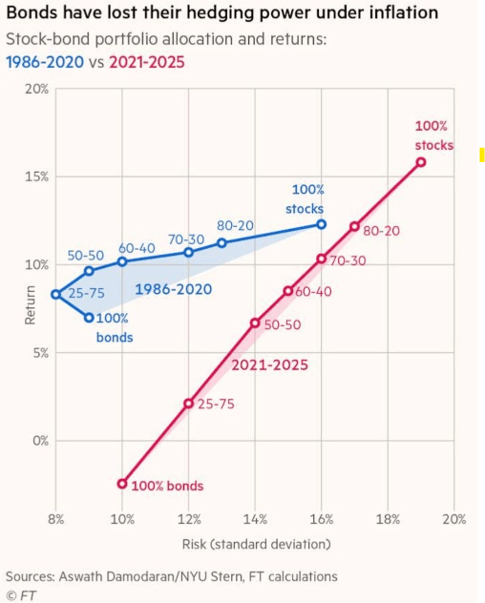
“For decades, the 60-40 stock and bond portfolio — or something close to it — allocation model was the universal standard: capture growth with equities and offset risk with bonds…
…But since 2021, with the return of high inflation, bonds are less and less useful as a diversifier. Looking at the average risk and return across various stock/bond weightings (using annual returns for the S&P 500 and 10-year Treasury), not only has risk increased all across the board since 2021, but bond returns have been negative. In short, correlation between stocks and bonds has turned positive, meaning bonds have started contributing to equity losses, instead of offsetting them.”
As we write, front month oil futures are back near the highs, north of $100 a barrel. The Iran conflict is disrupting energy flows, and trend strategies are long oil and refined products, short bonds. Direct exposure to markets at the forefront of concern.
We have long written about the benefits of portfolios broadening the tools in the toolbox of diversification into trend following strategies as they give systematic exposures to a genuinely different risk premia, historically uncorrelated most of the time and negatively correlated in equity and bond crises. While the only perfect hedge is in a Japanese garden (although my now 80 year old English father may stake a pretty good claim), when building out diversified portfolios, this is a good combination. Long and short exposures in commodities, currencies and fixed income.
The mark of great writing is encapsulating the essence of a complicated idea in a memorable and accessible way. It’s more than a little humbling that this scene from Landman in a little over 20 seconds does a better job than our previous 90 blog posts and 8 whitepapers in explaining futures markets, economic risk and (with some poetic license) our approach to portfolio construction and CTAs (Managed Futures). In the show, Tommy Norris is a Texas oil fixer and explains oil pricing like this:
“You want oil to live above 60 but below 90. And don’t get me wrong, we’re still printing money at 90, but… gas gets up over $3.50 a gallon, it starts to pinch. It hits a hundred, every product in America has to readjust its price. $78 a barrel, that’s about perfect. You know, brings enough profit to keep exploring, but it don’t sting as much at the pump.”
Every now and then the market reminds you that the most dangerous risks aren’t the ones you can see coming. They’re the ones embedded in the risk management systems themselves. Value-at-Risk (VaR) shocks are one of those paradoxes in finance where the tools designed to keep portfolios safe can end up making everything worse. Understanding how they work, and why they matter, is essential for anyone managing leveraged portfolios or trying to make sense of the violent dislocations that periodically rip through markets.
The basic idea is straightforward enough. Many portfolios size their positions based on some measure of expected risk – typically volatility, asset correlation, and the resulting VaR. In calm markets, volatility is low, correlations are well-behaved, and risk models give you the green light to run bigger positions. Life is good, until something upsets the apple cart. Volatility spikes, correlations jump, everybody’s risk model says the same thing at the same time – cut risk.
Below is a deliberately simplified illustrative simulation to walk through the mechanics of a VaR shock. Think of it as a stylized version of what happens in the real world when a stress event hits a volatility-targeted portfolio, whether it’s a risk parity fund, a sector and factor neutral fund, a spread trader or a trend follower. Any leveraged strategy that dynamically adjusts exposure based on realized risk metrics.
We use two assets, each running around 15% annualized volatility in normal times, with correlations near zero. The portfolio targets a 15% volatility max and sizes positions accordingly. With two uncorrelated assets at 15% vol each, the math is generous as the diversification benefit from near-zero correlation means you can hold around 70-80% in each asset (roughly 1.5x total exposure) and still run portfolio-level volatility comfortably below the 15% limit, closer to 10%. That’s the beauty of diversification working as intended. Low correlations give you leverage capacity for free. The risk model sees calm vol, calm correlations, and allocates accordingly. Everything is in equilibrium. Now let’s break it.
Let’s be honest about what’s sitting in most “Alternatives” buckets. Privates.
Private equity is a company raising capital from investors to build and grow their business. Public equity is a company raising capital from investors to build and grow their business. The only real difference? The platform they raise money on. Same story with private credit versus public credit, it’s lending to companies either way.
These aren’t alternatives. They’re “Equalatives”—a made-up word for investments that appear different but are exposed to the same economic drivers as what you already own.
As we close out 2025 and look toward 2026, it’s worth taking a step back to think about how we build portfolios.
The traditional 60/40 stock-bond allocation has been the go-to for decades. It’s been taught in business schools, recommended by advisors, and quietly implemented in retirement accounts everywhere. But some of the world’s largest institutional investors have been evolving their thinking. The Total Portfolio Approach, championed by pension giants like CalPERS and CalSTRS, offers a different way to think about risk and return, creating compelling opportunities for diversifying strategies like managed futures.
But here’s the thing: for this approach to actually work, each portfolio element needs to do its job. And we need to stop judging them all by the same yardstick.
It’s late 1987. Institutional investors had just lived through the debacle of October 19, when the stock market collapsed, driven down by an idiotic idea … portfolio insurance. Shortly afterward, we had our first meeting with Rusty Olson, CIO of Eastman Kodak’s pension plan. Regardless of what you think of Kodak’s business acumen at the time, the pension plan was a star. Rusty was in the process of turning over every rock in the financial marketplace, looking for diversification for his very aggressive portfolio. He found us. We pitched him on the idea of managed futures as the ideal diversifier. Liquid, leverageable, and systematic. He loved it but with a caveat. We proposed a multi-manager managed account. But he, and his consultant, had no way of knowing how we were doing relative to some benchmark … there was no benchmark at the time. So we built one — the MLM Index. To my knowledge, it was the first rigorous, price based measurement of the risk premia available to futures traders.
Ask any self-respecting trend follower what kind of market environment favors their strategy, and you’ll get the usual suspects: volatility, uncertainty, macro and geopolitical stress, inflation, deflation, recession. But here’s the thing—those are just the conditions. The real driver? Signal versus noise. Trend needs signal.
In 2022, the signal was deafening: inflation fears, war in Ukraine, and ultimately, realized inflation. Since 2023? More like a symphony of noise. Just look at U.S. rates: 10-year yields dipped below 3.5% in April ’23 on recession fears… then hit 5% by October on “higher for longer.” They slid below 4% in Jan ’24 (soft landing), bounced to 4.5% by April (higher for longer again), dipped back under 4% in September (post-Yen carry unwind, recession vibes), then shot above 4.5% in Jan ’25 (pre-inauguration pro-growth Trump trade), and—you guessed it—dropped back under 4% in April (DOGE, tariffs, not pro-growth but outright recessionary).
2022 was a fantastic year for showcasing the benefits of adding Managed Futures to the portfolio. Inflation rears its ugly head after 40 years and commodities rip higher during the Ukraine War. Managed Futures, offering exposure to both the long and short sides of return distributions, got you long commodities and short bonds. No other asset class brought you that kind of protection in 2022. Not Gold, not TIPS, not Bitcoin. However, after down single digits in 2023, and another flat to down year in 2024 amid strong stock market results, the naysayers return.
Managed Futures – computers love us! Humans…not so much. Why is that? Take pretty much any sufficiently long Managed Futures track record, or index, run it through asset allocation models and efficient frontiers, the answer is pretty much always the same. Uncorrelated returns, with strong negative correlations in periods of market stress, lowers overall portfolio volatility and drawdowns. The efficient frontier goes up and to the left, improved returns, lower volatility, better portfolio Sharpe. The quants, and CFAs, and nerds all agree…on paper it works. For the seasoned veteran, the RIA, the institutional consultant, holding Managed Futures in a portfolio through time, not so easy with the clients.
We speak with a diverse range of investors—domestic and international, institutional and retail, alternatives-focused and equity-centric. Typically, they have a variety of questions and concerns driving their current thinking. However, in recent weeks, there’s been a singular focus: the return of President Trump. It’s remarkable how much of a Rorschach test he has become.
For macro topics like inflation or growth, we usually see a fairly narrow range of opinions—around 10-15% of people expecting slightly lower inflation, 10-15% anticipating it to be a bit higher, with most clustered near the target, expecting the status quo. Currently, not a single person thinks we are in a state of equilibrium. On one side, 50% believe we’re headed for runaway inflation fueled by exploding deficits, Fed pressure, eroding confidence in the USD, and soaring commodity prices due to global turmoil. The other 50% foresee a deflationary crisis spurred by the deportation of 10 million immigrants, a $2 trillion reduction in the federal budget, and a rampant USD disrupting emerging markets and driving commodity prices down. Adding to this uncertainty, President Trump, the world’s largest one-man volatility machine, has teamed up with perhaps the only person who could rival him, Elon Musk. Volatility squared.
These factors, among others, have realigned market assumptions, significantly increasing the likelihood of problematic inflation or deflation over the next twelve months. Investors face a FLATION complication.


You must be logged in to post a comment.